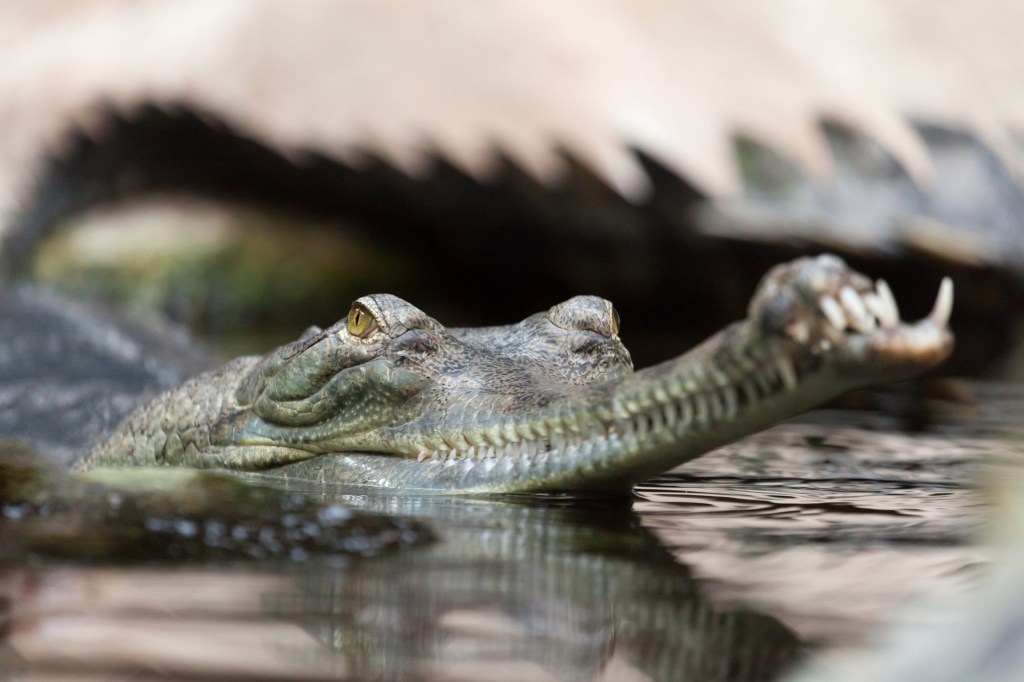
If you’ve never seen a gharial before now, you have to admit, it looks like something out of a horror movie with that misshapen snout and the rows of razor sharp teeth, but in actuality, this freshwater crocodile is far more threatened by us, as it is critically endangered with an ever decreasing population. Where it was once found in river systems from Pakistan to Myanmar, it now only lives in three rivers in India (the Chambal, Girwa and Son rivers) and one in Nepal (the Narayani River). For all of its menace, the gharial poses no threat to anything but the copious amounts of fish it consumes, which it catches after detecting their vibrations by whipping its head back and forth with its mouth open. They range in size from 12 to 15 feet long and weigh up to 2000 pounds. Their legs are incredibly short and unable to support its weight, so when a gharial does come on land to sunbathe, the best it can manage is a sliding belly crawl. Sill not convinced that these crocodiles won’t harm you? Would it help to know that the growth on the end of a male’s snout is called a ghara (the Hindu word for “mud pot”) and is just a mating tool? They will vocalize and blow bubbles with their snouts to attract females – the louder the sound and the more bubbles they make, the more likely they are to reproduce. Females lay their eggs on the riverbanks during the dry season, and after a 70 day incubation period, the babies hatch. They may stay with the mothers for anywhere between a few weeks to a few months before they depart to live a solitary life. Unfortunately, they are losing their battle for survival for two reasons. First, the ghara is harvested for alternative medicine (yet another presumed aphrodisiac like a rhino horn) which in no way actually cures anything and secondly, the gharial’s habitat is being destroyed by the building of hydroelectric dams. India did grant gharials full protection in the 70’s and conservation groups started captive breeding programs in the 80’s but there has never been sufficient monitoring to know if these programs have made a difference. I feel like this enigmatic creature deserves more from us than it’s gotten, don’t you?
Source: nationalgeographic.com/animals/reptiles/facts/gharial
 I Am A Voice For The Voiceless
Jennie another great article Your research and presentation are both informative and interesting. Thanks for sharing.
LikeLiked by 1 person