
Author’s Note: When I was a teenager, the “in” place to shop was Express and the company’s signature status symbol was their line of 100% silk clothing – although I couldn’t afford most of it, I did have a couple of silk scarves, a floral printed blouse and a blue pantsuit that graced my closet until the trend passed. If I’d known then what I do now about silk production, I would have reconsidered my choices.
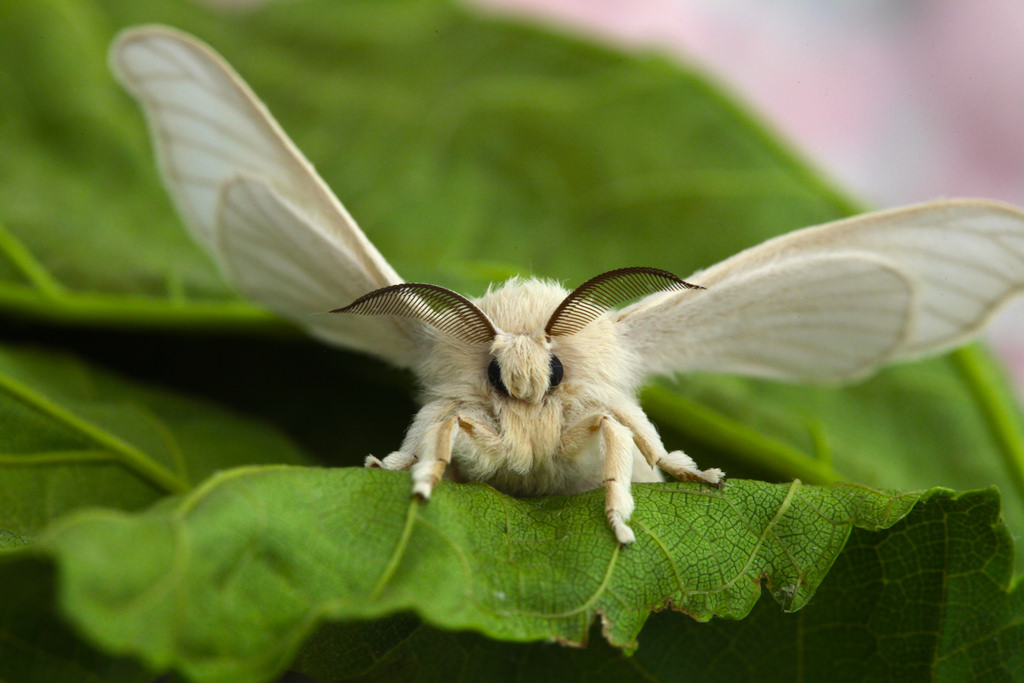
Meet the Bombyx Mori, one of a relatively small group of Saturniids in the silk moth family, and the one that is the most important to the commercial production of silk. These adorable little floofballs originated in Asia but no longer exist in the wild due to the toll sericulture (the harvesting of silk thread) has taken on the species. They are holometabolous, which means they have four distinct life stages – egg, larva, pupa, moth – and once the female moth lays eggs, she dies. The larvae hatch after ten days and they spend the next six weeks eating and growing; their diet consists of mulberry leaves, osage oranges and lettuce. Due to the domesticative nature of sericulture, the larvae cannot hang on plants to feed as they would do in the wild, so they must be hand fed. Their silk gland grows to be about 1/4 of their entire body weight and it’s this organ that makes the Bombyx Mori the master of its own demise because it allows the larva to spin a cocoon from one single silk thread about a half mile in length. In order to create the shimmery fabric we call silk, the thread must be harvested before the emergence of the moth breaks it, which means the cocoons must be boiled to kill the larvae before they pupate. Only then can the threads be harvested.
Fortunately there is a new cottage industry in India which could change the fate of the bombyx mori. Ahimsa Silk is a company started by Kusuma Rahaiah, a 60 year old government official from Andhra Pradesh. The name comes from the Sanskrit for “noninjury” which is the tenant in Jainism, Hinduism and Buddhism that concerns doing no harm to any living creature. Ahimsa silk is created from the cut silk thread after the moth emerges from the cocoon. Because the threads are shorter, they have to be woven together and produce silk that has less luster and a rougher texture than traditional silk. It takes ten days longer to produce to allow time for the larvae to pupate and produces 1/6 less silk, but I’d consider wearing it to protect these beautiful creatures from such a gruesome end.
 I Am A Voice For The Voiceless
Thank you for sharing this information. I didn’t know that this was the process by which original silk was produced. I agree with you that a rougher silk which allows the moth to live would see a much gentler way .
LikeLike